
As discussed in a previous article (Why are we testing perception sensors in winter conditions | Sim4CAMSens ), the advancement of Advanced Driver Assistance Systems (ADAS) and autonomous vehicles (AVs) depends heavily on robust perception sensors including radar, lidar, and cameras. These technologies enable essential safety functions such as object detection, lane keeping, adaptive cruise control, and emergency braking.
- Lidar provides high resolution 3D mapping‑resolution
- Cameras deliver detailed visual information for classification and scene understanding
- Radar performs reliably across adverse weather and lighting conditions
Together, these systems underpin the safety and reliability of modern automated mobility.
The Real‑World Challenge: Contaminated Sensors
Despite their strengths, automotive sensors frequently encounter environmental contaminants during normal driving. Substances such as mud, water, sand, leaves, diesel, and gasoline can accumulate on sensor surfaces and disrupt performance.
These contaminants can lead to:
- Signal attenuation
- Increased noise
- False classifications
- Complete sensor failure
Previous studies have explored how contaminants such as water, ice [1], sand [2], and fuel residues [3] affect radar performance. Similar research exists for lidar and cameras [4,5]. Yet surprisingly, the impact of mud, a highly common contaminant in rural and off‑road environments, remains largely unstudied.
Why Mud is a Unique and Critical Contaminant
Mud presents far more complex challenges than other contaminants due to its variable composition, thickness, and water content. Unlike water or ice, mud has intricated dielectric properties that interact with radar signals, laser beams, and optical systems in unpredictable ways.
Impact on Radar
- Severe signal attenuation
- Increased scattering, causing inaccurate readings
- False range measurements
- Complete blockage of outgoing or returning radar waves
Impact on Lidar
- Blocking or scattering of laser pulses
- Degradation of 3D point cloud data‑cloud data
- Reduced obstacle detection accuracy
Impact on Cameras
- Lens obstruction
- Reduced image clarity and contrast
- Impaired object classification and scene understanding
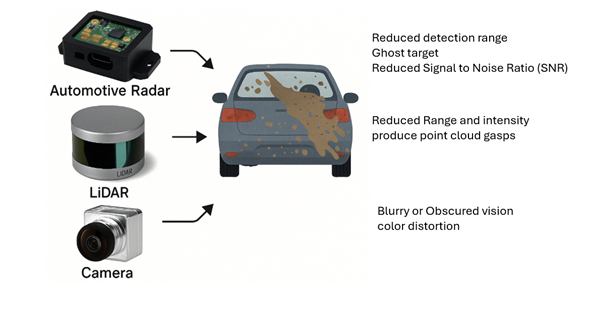
Figure 1: The impact of mud on automotive radar, lidar, and camera sensors
Why This Gap in Research Matters
The lack of comprehensive research into mud related sensor degradation presents a major challenge for advancing ADAS and autonomous driving technology. Vehicles operating in rural, agricultural, construction, or off road environments are especially vulnerable.
Without accurate understanding of mud’s physical and electromagnetic effects, systems may suffer:
- Misclassification of road users
- Reduced situational awareness
- Safety critical failures
To date, no holistic study has examined how different mud compositions affect radar, lidar, and camera systems simultaneously, representing a crucial gap in ADAS and AV R&D.
Enhancing Automotive Simulations With Real Mud Data
Beyond direct sensor performance, this research has major implications for simulation environments, which are central to ADAS and AV development.
By integrating real mud attenuation data into simulation tools, developers can:
- Accurately model sensor degradation
- Test algorithms under controlled but realistic conditions
- Validate perception pipelines across variable mud thicknesses, compositions, and moisture levels
Enhanced simulation fidelity supports:
- More robust sensor fusion architectures
- Improved signal processing algorithms
- Reduced physical testing costs
- Faster development cycles
This capability is essential for creating AV systems that remain reliable under real world conditions, not just clean, controlled laboratory scenarios.
The SiM4CAMSens Approach: Closing the Research Gap
As part of the SiM4CAMSens project, we aim to conduct the first comprehensive investigation into how mud affects radar, lidar, and camera sensors.
Our approach includes:
1. Controlled Laboratory Experiments
- Systematic variation of mud composition
- Precise changes in water content
- Defined layer thicknesses
- Measurement of signal attenuation and distortion across sensor types
2. Real‑World Dynamic Testing
- Natural mud spray accumulated under real driving conditions
- Analysis of sensor degradation during varied speeds, terrains, and weather
- Cross comparison with controlled lab data
3. Integration Into Advanced Simulations
- Building accurate mud interaction models
- Improving sensor fusion and perception algorithms
- Supporting the development and validation of ADAS and AV systems
Through this combined empirical and simulation based methodology, SiM4CAMSens aims to deliver the industry’s most accurate models for understanding and mitigating mud related sensor degradation.
Conclusion
Mud contamination is a critical yet understudied challenge for ADAS and autonomous vehicles. Unlike more predictable contaminants, mud’s variable physical and electromagnetic properties cause severe and complex degradation across radar, lidar, and camera systems.
By rigorously studying these effects and integrating the findings into advanced simulations, the SiM4CAMSens project will help improve sensor reliability, enhance perception accuracy, and accelerate the development of safer, more capable autonomous systems.
Written by: Shahrzad Minooee Sabery – Sensor Engineer
Please get in touch if you have any questions or have got a topic in mind that you would like us to write about. You can submit your questions / topics via: Tech Blog Questions / Topic Suggestion
references
[1] Arage, A., Steffens, W. M., Kuehnle, G., & Jakoby, R. (2006, March). Effects of water and ice layer on automotive radar. In Proc. of the German Microwave Conf.
[2] Alhuwaimel, S., Mishra, A., & Inggs, M. (2012, September). Review of radar signal attenuation due to sand and dust storms. In 2012 International Conference on Electromagnetics in Advanced Applications (pp. 1096-1099). IEEE.
[3] Norouzian, F., Marchetti, E., Hoare, E., Gashinova, M., Constantinou, C., Gardner, P., & Cherniakov, M. (2019). Experimental study on low‐thz automotive radar signal attenuation during snowfall. IET Radar, Sonar & Navigation, 13(9), 1421-1427.
[4] Schlager B, Goelles T, Muckenhuber S, Watzenig D. Contaminations on LiDAR sensor covers: Performance degradation including fault detection and modeling as potential applications. IEEE Open Journal of Intelligent Transportation Systems. 2022 Oct 12;3:738-47.
[5] Trierweiler M, Peterseim T, Neumann C. Automotive LiDAR pollution detection system based on total internal reflection techniques. InLight-Emitting Devices, Materials, and Applications XXIV 2020 Feb 25 (Vol. 11302, pp. 135-144). SPIE.